The Oceans of Europa and Enceladus: Where We'll Actually Find Life First
Forget little green men. The most credible search for extraterrestrial life is happening much closer to home — beneath the ice of two small moons in our own solar system.
By ÆTHERION Editorial
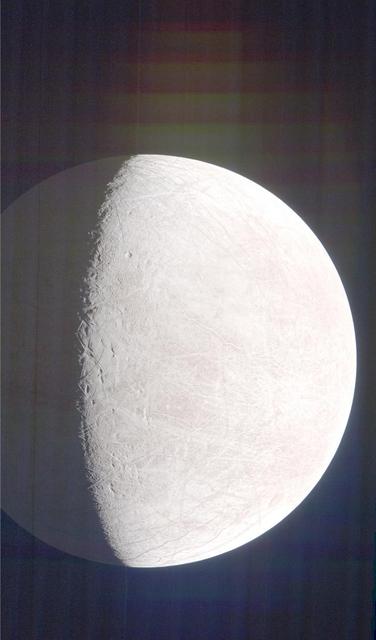
If life beyond Earth is discovered in your lifetime, it almost certainly will not announce itself in a spacecraft over a city. It will be a microbe, or the chemical fingerprint of one, found in the dark ocean of a frozen moon — and the leading candidates already have names: Europa, orbiting Jupiter, and Enceladus, orbiting Saturn.
Worlds of hidden water
Both moons are wrapped in shells of ice, and beneath that ice lies liquid water — not as a hopeful theory but as a conclusion drawn from hard data. Europa's surface is a fractured, refrozen landscape that strongly implies a global ocean below, possibly containing twice the water of all Earth's oceans combined. Enceladus is even more dramatic: the Cassini spacecraft flew directly through plumes of water vapor erupting from cracks at its south pole, and tasted them.
What Cassini found in the plume
That sampling was historic. In the Enceladus plumes, Cassini detected water, salts, and — crucially — complex organic molecules and molecular hydrogen. On Earth, molecular hydrogen at the sea floor feeds entire ecosystems through hydrothermal vents, where life thrives in total darkness on chemistry rather than sunlight. Enceladus appears to have the same ingredients and possibly the same energy source.
This matters because it satisfies, on paper, the three things life as we know it requires: liquid water, the right chemistry, and an energy source. Nowhere else off Earth have we confirmed all three together.
The missions that could answer it
This is why space agencies are going. NASA's Europa Clipper, launched in 2024, will make dozens of close flybys of Europa to assess its habitability in detail. Concepts for landers and even 'cryobots' that would melt through kilometers of ice to reach the ocean below are under serious study. A mission to fly through Enceladus's plumes again — this time with instruments built specifically to detect biosignatures — is among the most scientifically compelling proposals in planetary science.
The aliens we find first will probably be too small to see — and that would be the most important discovery in human history.
It is worth sitting with what that would mean. If we find even a single living microbe in Europa's ocean, arising independently of Earth, it tells us that life is not a freak accident but a regular outcome of the right conditions — which would imply a universe absolutely teeming with it. No glowing craft required. The most profound answer to 'are we alone?' may be waiting silently under the ice of a moon we can already see through a backyard telescope.