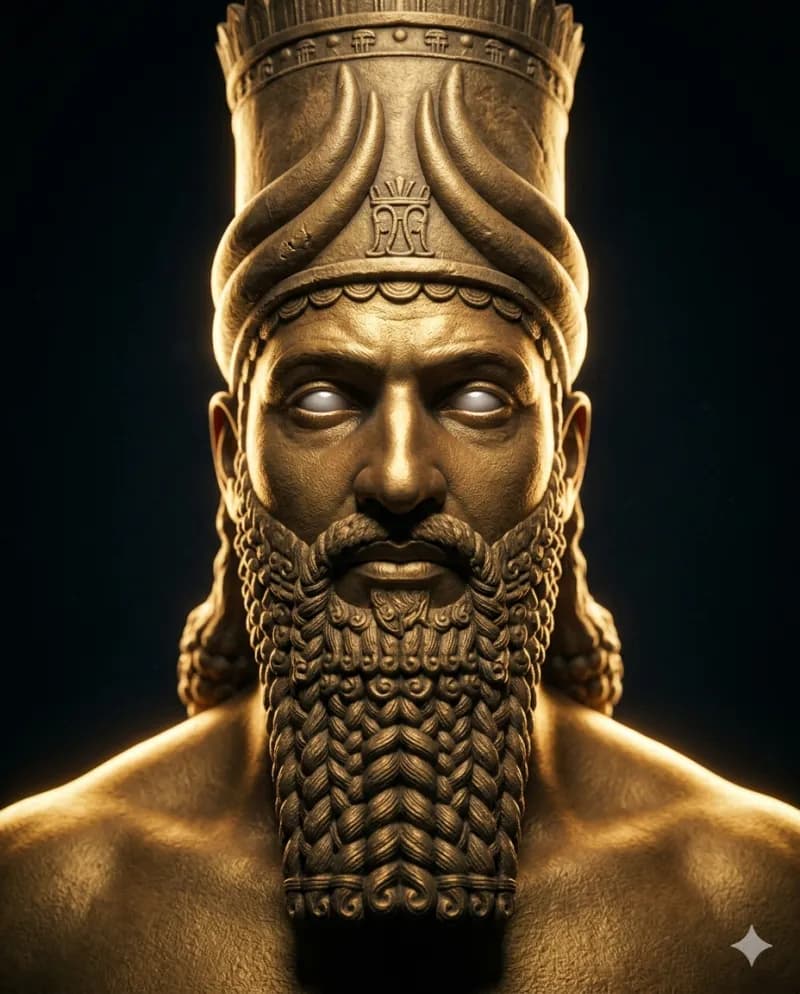
The Anunnaki
Colossal humanoids of god-like proportion, depicted in Sumerian relief as bearded, crowned, and winged — beings whose scale alone marked them as more than men.
Civilization did not dawn slowly. In Sumer it seemed to arrive almost overnight — writing, mathematics, astronomy, law, irrigation — and the Sumerians themselves credited none of it to their own genius. They credited the Anunnaki: beings who 'came down from the sky' and walked among them as gods.
In the 1970s, author Zecharia Sitchin offered a radical translation: that the Anunnaki came from a rogue planet, Nibiru, on a vast elliptical orbit, and that they genetically engineered Homo sapiens from existing hominids to mine gold. Mainstream scholars reject the translation entirely — yet the questions it raises about humanity's suspiciously sudden ascent have never fully gone away.
Whether the Anunnaki were gods, aliens, kings, or a misread metaphor, they occupy a unique place in the catalogue: not visitors to humanity, but — if the believers are right — its authors.
“They shaped man from clay and the blood of a god, and set him to labour.” — Enūma Eliš (paraphrase)
Temperament
- ◇Imperial, demanding, jealous
- ◇Creators who treated humanity as labour
- ◇Capable of both gift and wrath
- ◇Worshipped, feared, and ultimately departed
The Agenda
Genesis, then extraction. The Sitchin interpretation holds that the Anunnaki engineered modern humans from earlier hominids as a mining workforce — and may one day return to collect on creation.
How to know one
- ►Echoes in every flood myth on Earth
- ►Sudden 'gifts' of agriculture, law, and astronomy
- ►Temples aligned to bodies we only recently mapped