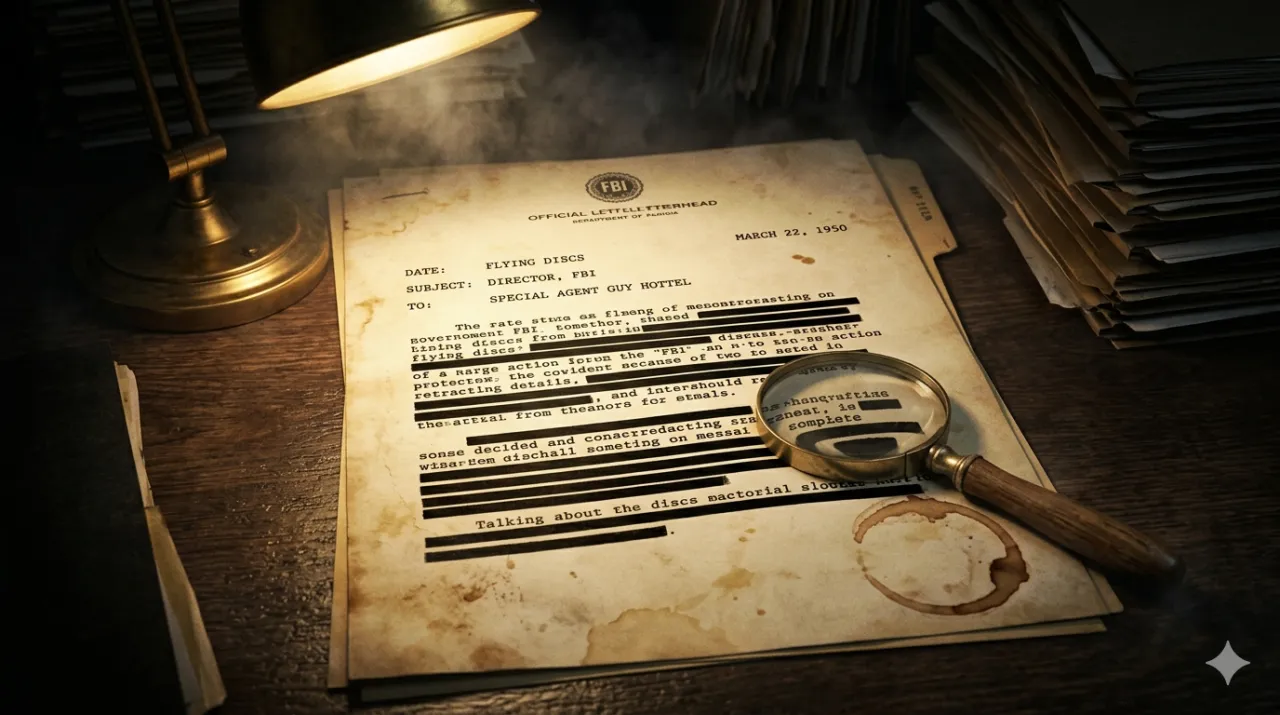
The Hottel Memo (FBI Vault)
The most-viewed document in the FBI's history is about flying saucers.
A 1950 memo from FBI Special Agent Guy Hottel reports that three 'flying saucers' were recovered in New Mexico, each carrying three bodies of human shape but only three feet tall. It sits, fully declassified, on the Bureau's own website.
It is one thing for a tabloid to claim recovered saucers; it is another for the document to bear the letterhead of the Federal Bureau of Investigation. The Hottel memo, dated 22 March 1950, relays an informant's account: three flying saucers recovered in New Mexico, each occupied by three bodies of human shape but only about three feet tall, clad in metallic fabric of a very fine texture.
The FBI itself has gone to lengths to deflate it — noting the memo is a third-hand report, that it predates any Bureau investigation, and that no follow-up was ever conducted. It is, they stress, a record of a claim, not a confirmation of one.
And yet: when the FBI digitised its archives into 'The Vault,' the Hottel memo became, by a wide margin, the most downloaded document the Bureau has ever published. The public made its choice about which file mattered.
- ■The Hottel memo, hosted on the FBI's official Vault (vault.fbi.gov)
- ■Its status as the most-accessed document in FBI history
- ■Striking consistency with Roswell-era 'three-foot being' descriptions
Genuine document, unverified claim. The FBI wrote it down, filed it, and — whatever its truth — could never make the public stop reading it.